Get Full Government Meeting Transcripts, Videos, & Alerts Forever!
Get email alerts on the Farmers Markets topic
No spam. Unsubscribe anytime.
Council hearing spotlights Farmers Market Support Amendment Act, witnesses press for streamlined permitting and funding
Summary
The Committee on Health heard testimony in support of the Farmers Market Support Amendment Act of 2025, B26‑6109, emphasizing streamlined permitting, a grant program for markets in low-food-access areas, and technical assistance administered by D.C. Health.
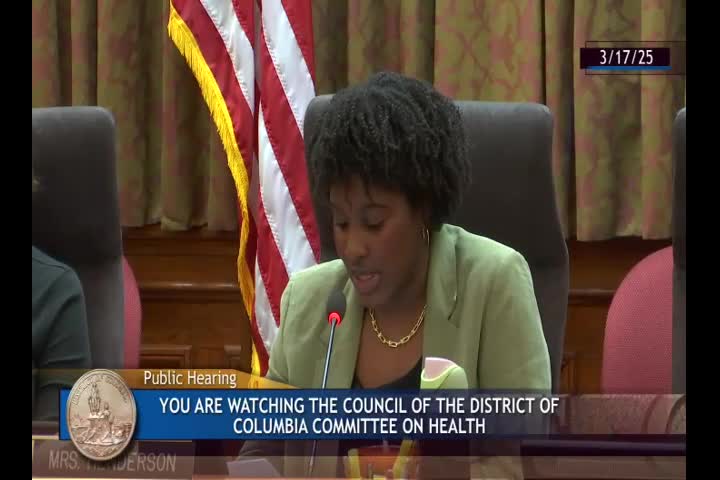
Councilmember Christina Henderson, Chair of the Committee on Health, brought the committee’s public hearing to order Monday to consider B26‑6109, the Farmers Market Support Amendment Act of 2025, which would create a Farmers Market Support Program at the Department of Health and establish at least $250,000 per year in grants to support markets in areas with low food access.
The bill, introduced in February with Councilmembers Allen, Freeman, K. Bonds (Doe), Parker and Robert White as co‑sponsors, would provide technical assistance, a designated permit pathway, discounted licensing in low‑access areas and a grant program to help markets expand operations, cover infrastructure costs and extend seasons. Chairperson Henderson said there are currently 53 independent farmers markets in the District and that about 330,000 residents live in areas classified as low food access.
Why it matters: witnesses testified that farmers markets act as both public‑health interventions and economic engines — supplying fresh produce, supporting small and regional producers, and creating community gathering places — and that permitting, fees and inconsistent agency coordination often block markets from opening or expanding in neighborhoods that need them most.
Farmers market operators, food‑access nonprofits, growers and public‑health experts told the committee the bill’s grant fund and technical assistance are urgently needed. Rebecca Chavez, director of agricultural programs at FreshFarm, said FreshFarm operates 19 markets and that its network generated roughly $29.8 million last year for 268 regional farmers and food producers, one‑third of whom are based in D.C. Chavez urged the committee to include a single, citywide market permit to replace the patchwork of approvals that typically involve multiple permits and reviews by many agencies.
“A single farmer’s market in D.C. may require up to five different permits reviewed by up to 13 different agencies,” Chavez said. She told the committee that the permitting process is “redundant” and “cost prohibitive,” describing a request earlier in the season for FreshFarm to pay more than $10,000 to host a market at the Columbia Heights Civic Plaza.
Several market operators described routine operational costs and administrative burdens that reduce funds available for food access. Pamela Hess of Arcadia Food recalled buying wholesale from regional producers and running mobile markets that serve Wards 7 and 8. Hess said mobile markets had moved more than $2 million worth of food into D.C. neighborhoods since 2012 and that some market operations needed roughly $5,000 per stop in current permit or licensing costs, money that otherwise would pay for food or market operations.
Stefan Templeton, executive director of the Farmers Alliance, and other speakers framed the bill as a resilience initiative: local markets and mobile vendors can serve as alternate food distribution channels during supply‑chain disruptions. Mark Scott, a former D.C. Homeland Security and Emergency Management Agency employee, told the committee his prior HEMA study found low‑access areas would be disproportionately affected by supply disruptions and that local markets can provide backup sources of supply.
Market managers also described how permitting problems manifest in practice. Petworth Community Market board member Shannon Stokes said her volunteer board spends significant time obtaining seasonal permits and that past permit misclassifications and meter fees delayed or jeopardized market operations. Bloomingdale Farmers Market manager Brianna Hartman said her market recently transitioned to year‑round operations and needs sustained financial support to keep extended operations viable.
Food‑rescue and food‑access groups told the committee the bill could also increase donations of surplus produce to distributions serving seniors, veterans and low‑income families. Kate Urbank of Food Rescue USDC said volunteers regularly collect surplus from markets and that expanding markets would increase available donations for social‑service partners.
What DC Health told the committee: Sarah Beckwith, Bureau Chief for Health Promotion and Disease Prevention at D.C. Health, testified in support and described how the program would be housed and administered. Beckwith said the bill would require the department to publish a consolidated guide to all licensure and permitting requirements, create a publicly available map of farm retail outlets, provide equipment and marketing support and administer at least $250,000 in grants annually targeted to low food access areas. D.C. Health told the committee it would need resources to implement the program if enacted and recommended, as a technical change, that community‑supported agriculture programs (CSAs) be eligible for assistance under the bill.
Beckwith also cited health disparities the legislation seeks to address: D.C. Health data shows Black residents report diabetes at higher rates than white residents and that Ward 8 residents are more likely than the district average to report high blood pressure. The bureau estimated that 30.12% of the District’s population lived in low‑food‑access tracts as of March 2023, concentrated in Wards 5, 7 and 8 under the bill’s cited definition.
Points of emphasis from witnesses: several market operators urged the committee to prioritize a single, streamlined market permit; operators in neighborhoods with fewer grocery stores requested discounted or waived fees for market licensing in low food access areas; and managers asked for defined grant uses to include tents and signage, marketing, staffing, storage, incentives for SNAP/Produce Plus customers and funding to extend seasons. Operators and advocates emphasized visibility, consistency of hours and outreach as key to building sustained market participation.
No vote was taken at the March 17 hearing. Chairperson Henderson said the public record would remain open through March 31 at 5 p.m. for written testimony and that the committee would request additional written testimony from the Departments of Transportation and Parks and Recreation.
A closing note: D.C. Health and witnesses repeatedly framed the issue as public‑health policy, arguing that improving access to fresh produce via markets can prevent diet‑related chronic disease and reduce downstream health costs. The bill would create a new program at D.C. Health to coordinate the district’s regulatory and grant responses to that ambition.