Get AI Briefings, Transcripts & Alerts on Local & National Government Meetings — Forever.
Senate finance committee backs $103.3 million ENRTF package; technical amendment shifts Bay West funds to Freshwater Society
Loading...
Summary
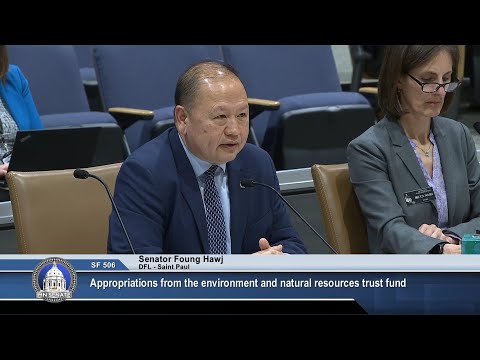
Senate File 506, the annual Legislative Citizen Commission on Minnesota Resources appropriation bill, was recommended to pass by the Senate Finance Committee on March 4, 2025, sending approximately $103.3 million to 124 environmental and natural-resources projects statewide.
Senate File 506, the annual appropriation package for the Environment and Natural Resources Trust Fund (ENRTF) developed by the Legislative Citizen Commission on Minnesota Resources (LCCMR), was recommended to pass by the Minnesota Senate Finance Committee on March 4, 2025.
Senator Hur, the bill author, told the committee that the package "includes over 103 millions in funding for 124 environmental and natural resources projects across our state." The bill contains project recommendations developed through LCCMR's nine-month bipartisan process and submitted as a single appropriation bill for legislative consideration.
Why it matters: The ENRTF is a constitutionally dedicated fund that supplies a major source of state funding for environmental projects statewide. Becca Nash, director of the LCCMR, told the committee that "the trust fund is operated similar to an endowment," explaining that the commission recommends projects financed from a percentage of the fund's value each year. Nash also noted that a November 2024 constitutional amendment raised the possible drawdown from 5.5% to 7%, with the additional 1.5% designated for a new DNR community grants program; that new community grants funding is not included in this bill.
What the bill would fund: The package recommends approximately $103,326,000 for 124 projects selected from 214 applications requesting about $183,000,000. Nash walked committee members through subdivision-level funding allocations printed in members' packets, including: Subd. 3 (foundational data) $22,084,000; Subd. 4 (water resources) $11,812,000; Subd. 5 (environmental education) $11,965,000; Subd. 6 (invasive species) $6,713,000; Subd. 7 (air/climate/renewables) $11,744,000; Subd. 8 (methods to protect/restore land/water/habitat) $12,188,000; Subd. 9 (land acquisition, habitat, recreation) $19,553,000; and Subd. 10 (administration, emerging issues, contract reimbursement) $7,267,000.
Technical amendment A1: Senator Eichorn moved a technical A1 amendment to change the lead recipient on one project from Bay West LLC to Freshwater Society. Nash described the change as a partner-requested administrative update: Freshwater Society will be the lead nonprofit receiving the funds while continuing to partner with a for-profit consultant. The committee approved the A1 amendment (voice vote); the motion "prevails," according to the clerk's announcement.
Extension and carry-forward questions: Members pressed LCCMR staff about carry forwards and extensions of prior appropriations. Nash said many extensions stem from COVID-related delays, supply-chain and hiring difficulties, and flooding that disrupted restoration and construction timelines. She said most extensions are one year, with a few at two years, and that the commission approves carry forwards only when there is a compelling reason and strong prospect of project completion. Fiscal staff also explained a new budgeting rule that requires identifying amounts that otherwise would have canceled and showing extensions in omnibus bills.
Jasinski A2 amendment (failed): Senator Jasinski offered an A2 amendment that would have shifted $335,000 from a northern Minnesota project addressing toxic algal blooms to extend three active southern Minnesota water-quality projects (Fergus Falls, Rice County/French Lake, and a new Blue Earth County project) and provide two-year extensions. Senator Jasinski argued the technology in the southern projects was already deployed and yielding improvements. Senator Hir (author) and others cautioned that the LCCMR process vets projects across the state and that midstream reallocations risk undermining that process.
A roll-call on the A2 amendment resulted in a 6-6 tie, and the amendment failed. Recorded A2 votes: Marty—No; Friends—Yes; Pratt—Yes; Champion—No; Dames—Yes; Draheim—Yes; Eichhorn—Yes; Jasinski—Yes; Mohammed—No; Murphy—No; Pappas—No; Wicklund—No.
Final committee recommendation: Senator Pappas moved that SF 506 be recommended to pass. The committee approved the bill by roll call, 10-2. Recorded vote on SF 506: Marty—Aye; Friends—Yes; Pratt—Yes; Champion—Yes; Dames—Yes; Draheim—No; Eichhorn—No; Jasinski—Aye; Mohammed—Aye; Murphy—Yes; Pappas—Yes; Wicklund—Yes. The committee record shows the bill as passed out of the Finance Committee and sent on its way for further legislative action.
Committee and staff follow-up: Nash and LCCMR staff said they will coordinate additional briefings as requested (committee members asked staff to connect University of Minnesota project leads with senators who raised questions). Fiscal staff noted they will apply the new budget rule to carry-forward disclosures in future omnibus bills.
Votes at a glance
- A1 amendment (technical; change lead recipient from Bay West LLC to Freshwater Society): passed (voice vote; mover: Senator Eichorn). - A2 amendment (Senator Jasinski; reallocate $335,000 to extend three southern Minnesota water-quality projects): failed, roll-call 6–6 (mover: Senator Jasinski). - Final motion recommending passage of Senate File 506: passed, roll-call 10–2 (mover: Senator Pappas).
The committee hearing also included discussion of the composition of LCCMR awards (Nash noted funding to universities, state agencies and local units of government is detailed in members' packets), and members emphasized interest in funding projects that produce measurable, near-term results as well as in preserving the LCCMR's bipartisan vetting process.
The committee adjourned after the vote; staff noted an upcoming forecast hearing and recognized departing staff.