Get Full Government Meeting Transcripts, Videos, & Alerts Forever!
Get email alerts on the Pathways Program topic
No spam. Unsubscribe anytime.
Committee advances bill to carve out long-stay nursing home residents from Pathways managed care
Summary
The House Public Health Committee voted to advance HB 1277, which would carve out long-stay nursing home residents from the state's Pathways managed-care waiver, set individual cost limits and create a standalone assisted-living waiver. Supporters say changes would cut Medicaid administrative costs; the administration raised implementation and fiscal questions. (Committee vote: 12-0.)
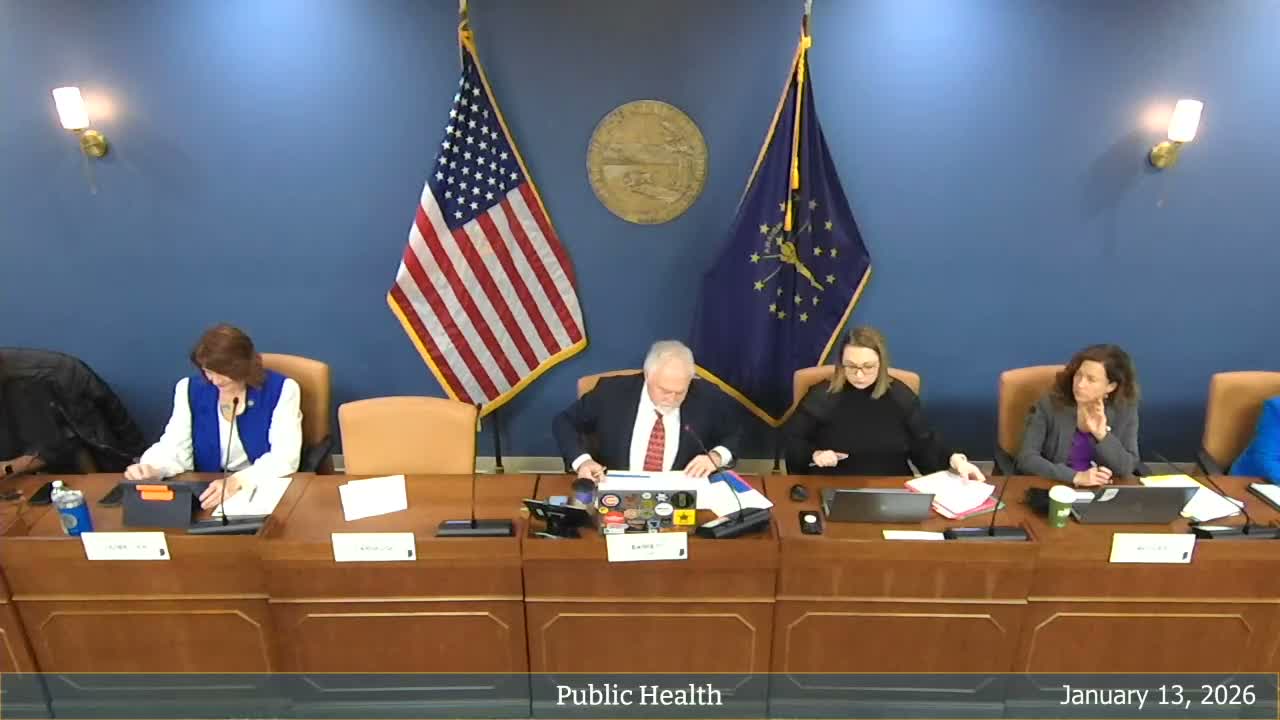
Chair Brad Barrett convened the House Public Health Committee to consider House Bill 12 77, a bill aimed at reshaping parts of the Pathways managed-care rollout for long-term services and supports. The committee approved the bill in a roll-call vote, 12 to 0, advancing it to follow-up fiscal review.
Nick Goodwin, director of government affairs for the Indiana Healthcare Association, told the committee the measure targets specific populations and program rules to reduce costs and administrative burden. "The intent here is to save hundreds of millions in Medicaid costs," Goodwin said, and he described four principal changes: carving out residents with 100 consecutive days in a nursing home from managed care, setting an individual cost limit for waiver services, creating a standalone assisted-living waiver, and giving beneficiaries the choice of who provides integrated health-care coordination.
Supporters argued the changes would both reduce administrative fees paid to managed care entities (MCEs) and improve access for people currently waitlisted for home- and community-based services. Goodwin cited waiting-list figures and comparative models from other states, saying similar carve-outs in larger states have produced large savings.
Brian Mitch Rowe, testifying for the Family and Social Services Administration (FSSA), acknowledged fiscal pressures and administrative progress since last year but warned the bill raises operational questions. He said there is "no fiscal on this bill" and noted the state does not have additional waiver slots built into the text, a potential barrier to moving assisted-living recipients between waivers. Rowe also described recent agency changes—including a newly launched fully integrated dual-eligibility system (FIDI)—that aim to reduce fragmentation between Medicare and Medicaid.
Industry witnesses including Yvonne Tanner, a registered nurse with long-term-care provider Brickyard Healthcare, and Eric Huxley of Lead and Age Indiana supported the bill. Tanner emphasized the acuity of the 100-plus-day population and said facility staff currently perform much of the hands-on coordination work: "The level of care and the continuum of care is still continued to be done at a facility level." Providers said the MCEs have not consistently delivered promised care coordination and that targeted carve-outs would reduce duplicative administration.
During committee questioning members pressed FSSA and witnesses for implementation details: how many waiver slots are currently used by assisted-living residents, how capitation and Medicare interplay for dual-eligibles, and whether carving out people who are institutional residents will shift costs or access problems elsewhere. FSSA agreed to provide more granular slot and uptake data.
Chair Barrett said the committee would pair the policy recommendation with a fiscal review by Ways and Means. The committee approved HB 1277 by voice and roll-call; the motion to approve was followed by a recorded vote of 12-0. The bill will now proceed for further fiscal consideration.