Lifetime Citizen Portal Access — AI Briefings, Alerts & Unlimited Follows
Alaska Senate resources panel hears fiscal case for AKLNG tax swap; lawmakers press assumptions
Loading...
Summary
The Senate Resources Committee continued review of Senate Bill 280, which would replace state and municipal property tax on the Alaska LNG project with a volumetric tax set initially at 6¢ per thousand cubic feet with a 1% annual increase after ramp-up. Presenters from the Department of Revenue and project advisers outlined modeling, revenue projections and uncertainties; members asked for follow-up on allocation, fiscal assumptions and whether the project truly requires the tax change.
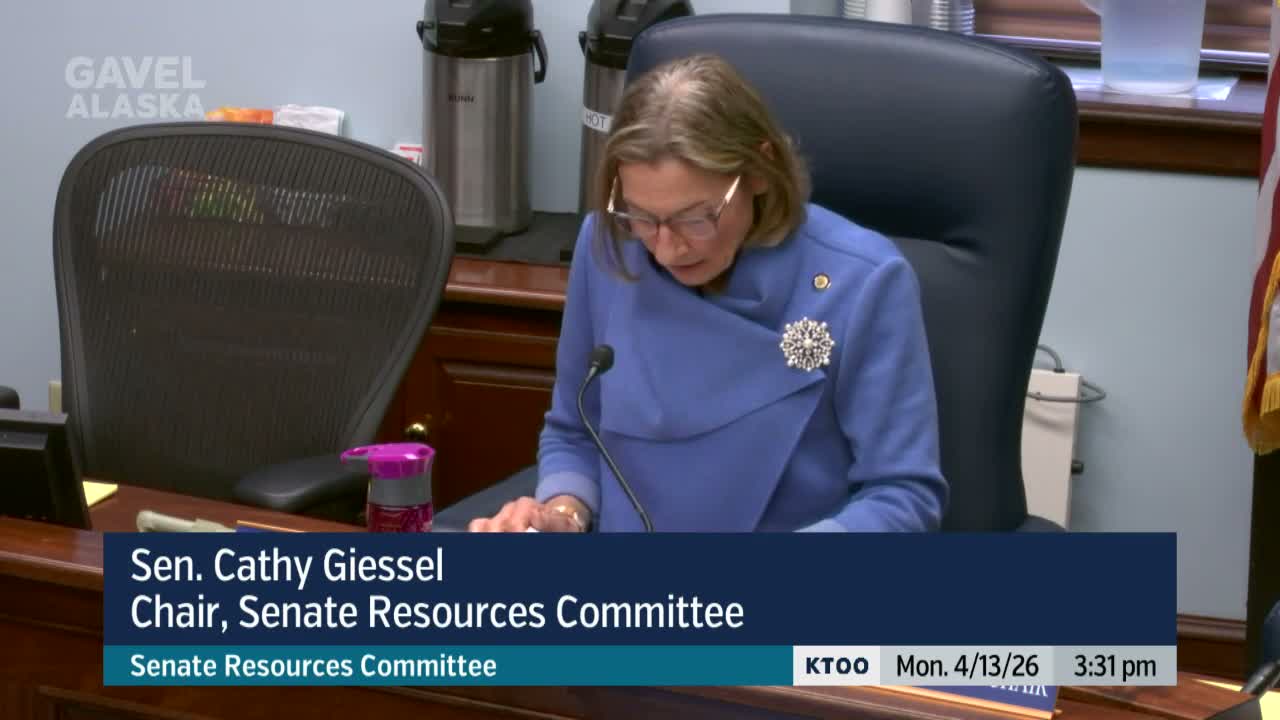
June 13, 2026 — The Senate Resources Committee on Monday continued consideration of Senate Bill 280, a bill that would exempt the Alaska LNG (AKLNG) project from existing state and municipal property taxes and replace them with a new alternative volumetric tax (AVT).
Dan Stickel, chief economist with the Department of Revenue, told the committee the AVT was modeled to be 6¢ per thousand cubic feet of throughput after a ramp-up period, with a 1% annual increase thereafter. "That would be set at 6¢ per thousand cubic feet of throughput in the project and then there would be a 1% annual increase on that rate," Stickel said during the presentation.
The department’s fiscal note treats the AVT as a positive fiscal change under one key assumption: the project will not go forward under current law without property tax relief. Stickel said the fiscal note shows revenue associated directly with the AVT in the first two years and that broader modeling (production tax, royalties, corporate income tax) indicates net state benefits over the life of the project.
Why it matters: Backers argue the AVT lowers a front‑end burden that deters developers, improves alignment between throughput and local compensation, and — in modeling — yields net state revenues over the long run. Opponents and some committee members said the department’s assumption that the project would not proceed without tax relief is consequential and asked for evidence and scenario analysis.
Benchmarking and the 6¢ figure
Matt Kissinger, who participated for the project proponents, said the 6¢ figure was chosen after benchmarking other LNG regimes and tax systems, not because a developer demanded that exact rate. "No. This number came about through our benchmarking with other regimes ... and seeing that we were about one full order of magnitude higher than them," Kissinger said, adding that developers did not tell the state that they would categorically refuse to build without that precise number.
Committee scrutiny and numbers
Senators pressed presenters on allocation rules (how much of the line sits on state land versus municipal land), the treatment of spur lines such as the Fairbanks spur, and administrative costs to implement a new tax type. Stickel said the department modeled roughly 36.5% of the pipeline value on state (unorganized borough) land for some components and about 12.2% of project capital attributed to areas where the state would receive the AVT share, with the remainder attributable to municipalities.
Lawmakers also flagged disagreements and a verbal misstatement in the hearing. Senator Wilikowski pressed for exact breakout numbers; Stickel acknowledged he had misstated a rough estimate earlier and said he would correct the record. "I misspoke. I apologize, and I'll correct the record," Stickel told the committee.
Revenue profile and timing
Under DOR’s modeled baseline, the AVT scenario produces lower state property‑tax receipts for the midstream project compared with current law in the near term but becomes net positive by around 2031 when production and related upstream benefits are realized. Stickel said the department’s long‑run modeling shows roughly $9 million per year to the state from the AVT at full operations and municipalities receiving an estimated $64–65 million per year from the AVT’s municipal share in that modeled scenario; the department also projects substantial upstream production‑tax and royalty benefits over the project life.
Costs and administration
Stickel said implementing the AVT would create a new tax type in DOR and require additional staff and one‑time IT upgrades: the fiscal note requests one additional permanent staff position (roughly $170,000 per year) and a $250,000 one‑time upgrade to DOR’s tax revenue management system.
Uncertainties and next steps
Presenters repeatedly highlighted modeling uncertainties: gas and oil price trajectories, capital‑cost risk (DOR used a roughly $46.2 billion construction cost in 2026 dollars), market timelines, feed‑study completion and the sensitivity of outcomes to different assumptions. Senator Dunbar pressed the department on near‑term revenue dips and the policy levers that could shift revenues across years; she warned the committee that short‑term losses could translate to cuts in local services. "But that little dip right there to me represents closed elementary schools in Anchorage," Senator Dunbar said.
The committee requested follow‑up on several technical questions, including a written response from the Department of Law on whether certain borough‑owned facilities would be state‑tax exempt, a corrected breakout of state vs. municipal property‑tax impacts under current law, and additional sensitivity runs on alternate mill rates and AVT adjustments. The hearing continues tomorrow at 9:00 a.m.
What’s next: The committee adjourned with direction that Stickel return to continue the presentation and that Gaffney Klein would present subsequently; no formal motion or vote occurred Monday.