Get Full Government Meeting Transcripts, Videos, & Alerts Forever!
Get email alerts on the School Construction topic
No spam. Unsubscribe anytime.
Quakertown Community SD holds Act 34 hearing on new elementary school; project cost pegged at about $60.7M, financing would equal ~6.72‑mill tax impact
Summary
The Quakertown Community School District held an Act 34 hearing presenting a plan to replace Quakertown Elementary with a new 600‑student, two‑story school estimated at a $60.66M total project cost and an advertised Act 34 construction cost of $48.55M; PFM advised financing via general obligation bonds that would add about 6.72 mills in tax equivalent, and no public comments were offered at the hearing.
Quakertown Community School District officials on the evening of the Act 34 hearing presented plans to build a new two‑story Quakertown Elementary School and described the project scope, cost estimates and financing plan. Dr. Lisa Hoffman led the project history and need presentation, saying the district’s multiyear planning and enrollment projections through 2033 showed capacity and aging‑facility concerns that prompted the board to prioritize a new elementary school over other options.
The project the district advanced calls for a new 600‑student, roughly 94,000‑square‑foot elementary school sited adjacent to the existing building, which the district plans to demolish after moving students temporarily to a sixth‑grade center. "This section will just briefly go over the project history and the need for construction," Dr. Lisa Hoffman told the hearing, summarizing capacity analyses, facility assessments and the board’s 85% target building‑capacity guideline.
Architect David Schrader outlined the design and site plan: clustered classroom wings, a central dining commons and learning courtyard, a full‑size community gymnasium, and separated parent drop‑off and bus loading areas. "I represent the architectural side, and I'll start this evening with the concept options considered," Schrader said, and described three options the district considered before choosing the 600‑student build‑adjacent‑then‑replace approach.
On costs, the district presented a CHA cost estimate that excluded $22,379,379 of sixth‑grade‑center upgrades to isolate the new‑construction total. That produced a total project cost figure of $60,659,012 and an advertised Act 34 maximum building construction cost of $48,546,230. Solicitor Jeff explained Act 34 parameters: a second public hearing is required if final new‑construction costs exceed the advertised Act 34 cost by 8% or more, and a project whose Act 34 cost exceeds the state’s aggregate building expenditure per‑pupil threshold may be subject to referendum. The presenters said the district’s Act 34 building cost ($48,546,230) is below the state aggregate benchmark cited in the presentation (49,937,508), so the project, as presented, would not trigger a referendum.
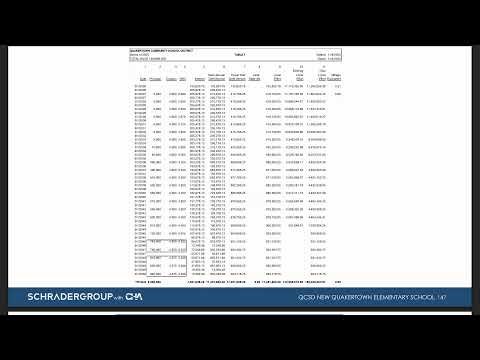
Jamie Doyle of PFM Financial Advisors summarized financing options and recommended a general obligation bond approach as the most cost‑effective. "Our job is to determine the most cost effective way of paying for the project," Doyle said. He noted one completed GEO series for $9,960,000 (series of 2025, with rates locked) and outlined estimated subsequent series: $20,000,000 (2026), $23,325,000 (2027) and $6,300,000 (2028). Doyle said estimated indirect annual operating costs tied to the new facility total $294,238 (support personnel, fuel/utilities, contracted maintenance/repairs and insurance), a millage equivalent of 0.67 mills; the bond issues themselves have a projected millage equivalent of 6.05 mills, producing a combined millage equivalent of about 6.72 mills.
A board member asked what a 6.72‑mill increase would mean for the average taxpayer; Doyle said he had not produced an average‑taxpayer calculation for the presentation but offered to work with the district business manager to prepare that figure. No members of the public spoke during the hearing; Dr. Hoffman closed the public comment period and the board adjourned the Act 34 hearing.
The hearing record includes the board’s prior resolution from its 03/26/2026 public meeting authorizing maximum project costs and directing the Act 34 hearing; attendees were directed to the hearing booklet and exhibits (D‑1 through D‑3) for more detail. The district said it advertised the hearing in The Morning Call on 04/02/2026 and provided materials for public review. The next procedural steps signaled in the hearing were (1) continued refinement of financing documents and (2) follow‑up calculations of taxpayer impact for public distribution.