Get Full Government Meeting Transcripts, Videos, & Alerts Forever!
Get email alerts on the Energy Taxation topic
No spam. Unsubscribe anytime.
Senate committee hears analysis that SB 280 would shift property-tax revenues, modestly lower in‑state gas costs
Summary
The Senate Resources Committee heard Department of Revenue testimony that Senate Bill 280 would replace portions of property tax with an alternative volumetric tax for the AKLNG project, cutting annual state property-tax receipts by roughly $230 million in the modeling for 2035 and lowering the modeled in‑state breakeven gas price modestly; witnesses and lawmakers debated municipal losses, consumer savings and regulatory safeguards.
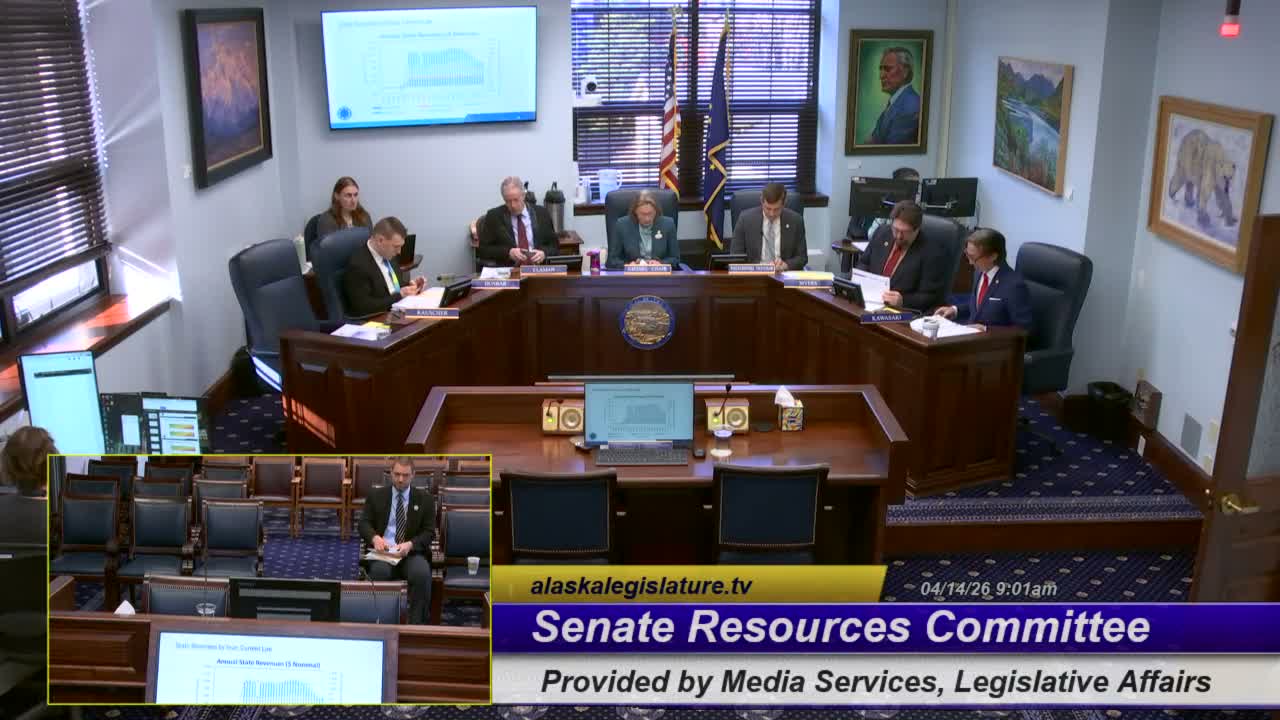
Juneau — The Senate Resources Committee on April 14 heard Department of Revenue analysis showing that Senate Bill 280, which would replace parts of the property tax regime for the Alaska LNG (AKLNG) project with an alternative volumetric tax, would shift large sums of revenue away from municipalities while delivering only modest reductions in modeled in‑state gas costs.
"For 2035 under current law and our baseline modeling assumptions, the state would receive $239,000,000 of property tax. And under the alternative volumetric tax, that would be $9,000,000 — for a $230,000,000 difference," Dan Stickel, chief economist for the Department of Revenue, told the committee. Stickel said municipalities’ receipts would fall in the department’s model from roughly $497,000,000 under current law to about $63,600,000 under the bill.
Why it matters: Supporters argue the change derisks the AKLNG project and lowers the developer’s breakeven cost, which can reduce the gas price available to Alaska utilities and industrial customers. Opponents warned the fiscal trade-offs would amount to billions of dollars in forgone property-tax revenue for local governments over the life of the project.
The numbers: Under the department’s 30‑year modeling through 2062, Stickel said the state would receive about $22.5 billion under the bill — roughly $7.2 billion less than under current law — and municipalities about $4.0 billion, roughly $13.3 billion less than under the current regime. Stickel said upstream producers and midstream owners would still capture substantial revenue; the department modeled a 10% rate of return for the midstream owner.
On consumer savings: Stickel and Department analyst David Herbert presented a separate estimate comparing in‑state delivered prices to hypothetical imported gas. "Our baseline here for in‑state gas would be $4.43 per thousand cubic feet," Stickel said; comparing that to an inflated imported‑gas price used in the analysis, the department estimated a savings of about $12.50 per thousand cubic feet to in‑state customers under the full AKLNG buildout. Using utility customer counts, the department estimated average household savings on the order of tens of dollars per year from the property‑tax change — a figure several senators contrasted with the per‑capita value of forgone public revenues.
"If you divide that $230 million by 600,000 Alaskans, that comes out to $383 per person," said Senator Wilikowski, illustrating the trade‑off between statewide fiscal receipts and household energy savings. "The average household in Anchorage… would save about $58.38," she said, using Enstar consumption figures, while cautioning the municipal revenue loss is separate.
Carbon credits and sequestration: The committee also heard that the department and project proponents include federal 45Q carbon‑sequestration credits in revenue modeling. David Herbert said the model assumes about 7.5 million tons of CO2 captured at the gas‑treatment plant per year and a current credit value near $85 per ton, rising with inflation. "By the time the project is running at full capacity, we're talking about $100 per ton of CO2," Herbert said, and estimated roughly $750 million–$900 million of transferable credits over the first 12 years under current law assumptions. Matt Kissinger of the Alaska Gasline Development Corporation (AGDC) said the base case assumes reuse of CO2 for enhanced oil recovery in the Prudhoe Bay area.
Risk and sensitivity: Stickel’s slides emphasized sensitivity to capital costs and gas purchase prices. The department’s baseline capital‑expenditure assumption for the full project is about $46 billion; if only a pipeline is built in a phase‑1 scenario, Stickel said delivered in‑state gas breakeven prices could be substantially higher (he cited a phase‑1 breakeven in the $10–$13/MCF range under some assumptions). Committee members pressed the department and AGDC representatives on whether cost overruns could be passed to utility customers; the witnesses said the modeling assumes the midstream developer would bear overrun risk and that long‑term sales contracts and RCA (Regulatory Commission of Alaska) review of utility purchases provide consumer protections, while the larger project would be under FERC jurisdiction for the export component.
"That is why we've modeled a 10% rate of return and shown what it implies," Stickel said, describing the modeling approach. Senator Dunbar called one slide "a wildly misleading graph" because a dotted volume line shares the slide with state‑revenue bars in a way he said could confuse the public; Stickel agreed to improve labeling and provide additional charts.
Follow up and next steps: The committee requested detailed, comparable slides showing the current‑law municipal/state breakdown and alternate assumptions such as scenarios where midstream entities pay corporate income tax. Stickel and staff agreed to provide the additional materials. Chair Senator Jerry Giesel closed the hearing and said the committee would reconvene April 15 at 3:30 p.m.
What it does not show: The hearing did not include a committee vote on SB 280. Several items in the Department’s presentation were modeled under specific assumptions (CapEx, producer purchase price, midstream return, 45Q credit values) and senators asked for sensitivity runs and clarifying documentation; the committee said it would require those follow-ups before advancing policy decisions.
(Reporting: Department of Revenue fiscal presentation to the Senate Resources Committee, April 14, 2026; committee chair: Senator Jerry Giesel.)